
Regenerative medicine
What Is BMAC Injection? A Complete Guide to Joint Preservation in Pakistan
What is BMAC injection? Learn how bone marrow aspirate concentrate works for knee osteoarthritis in Pakistan, clinical trial outcomes, limitations, costs, and candidate selection.
When exploring modern non-surgical options for chronic knee osteoarthritis, many patients ask: what is BMAC injection and how does it fit into orthopaedic care? Bone marrow aspirate concentrate (BMAC) is an autologous biological procedure in which a patient's own bone marrow is harvested, concentrated in a sterile centrifuge, and injected directly into an arthritic joint. Rich in mesenchymal stem cells (MSCs), platelets, and bioactive growth factors, BMAC works to calm chronic joint inflammation, alleviate pain, and support joint mobility.
In Pakistan, where advanced knee arthritis is common among individuals aged 55 and older, joint preservation strategies are gaining considerable attention. Dr Farooq Azam Khan provides the first BMAC programme in Lahore, establishing clinical pathways built on international protocols adapted into in-house guidelines. This complete guide provides an evidence-based overview of what BMAC is, what the published scientific literature demonstrates, where its clinical limitations lie, and how patients are assessed for treatment.
What Is BMAC Injection and How Does It Work?
BMAC stands for bone marrow aspirate concentrate. It is an autologous cellular preparation, meaning it is derived entirely from the patient's own body. During the procedure, bone marrow is aspirated typically from the posterior iliac crest (the pelvic rim) under local anaesthesia. The harvested marrow is immediately placed in a specialised centrifuge to separate red blood cells and isolate the concentrated cellular fraction.
As detailed in a comprehensive narrative review by Park et al. in Medicina (2025), BMAC is enriched with multiple biological components that act synergistically within the joint:
- Mesenchymal stem cells (MSCs): Multipotent progenitor cells capable of signalling local joint cells and modulating inflammatory cascades.
- Bioactive growth factors: Concentrated cytokines, including transforming growth factor-beta (TGF-β) and platelet-derived growth factors, that support tissue maintenance.
- Anti-inflammatory cytokines: Signalling proteins such as interleukin-1 receptor antagonist (IL-1Ra) that help suppress inflammatory joint breakdown.
Because BMAC is autologous, it possesses minimal immunogenicity, significantly reducing the risk of immune rejection compared to donor-derived treatments. Across published laboratory analyses reviewed by Park et al. (Medicina, 2025), MSC concentrations vary widely between 5 × 10⁶ to 10⁷ cells/mL depending on the preparation method, with improved clinical responses observed when colony-forming unit levels exceed 1000–2000 CFU/mL.
What Are BMAC Injections Used For in Orthopaedics?
In orthopaedic practice, BMAC is primarily used to manage degenerative joint disease, specifically knee osteoarthritis. Osteoarthritis is characterised by the progressive wear and loss of articular cartilage, accompanied by subchondral bone remodelling and chronic synovial inflammation. This leads to persistent pain, joint stiffness, reduced walking tolerance, and impaired daily function.
The primary clinical objective of BMAC in knee osteoarthritis is to buy healthy, active years before definitive joint replacement surgery becomes necessary. Rather than acting as a permanent resolution, BMAC serves as an advanced biological intervention designed to alter the intra-articular biochemical environment, reduce chronic discomfort, and help patients maintain an active lifestyle.
Beyond the knee, BMAC is also explored in specialised hip preservation protocols, such as an adjunct to core decompression in early-stage avascular necrosis, and in select tendon or cartilage procedures. However, the vast majority of clinical research and published evidence focuses on knee osteoarthritis.
BMAC vs Commercial Stem Cell Therapy in Lahore
Patients in Pakistan frequently encounter advertisements for commercial 'stem cell therapy' offered by cosmetic or wellness clinics. It is vital to understand how hospital-based orthopaedic BMAC differs fundamentally from these commercial offerings:
- Autologous and minimally manipulated: BMAC utilises the patient's own freshly harvested marrow, processed immediately at the point of care without laboratory cell culture, chemical alteration, or external expansion.
- Homologous orthopaedic use: The cells are harvested from musculoskeletal bone marrow and injected directly into musculoskeletal joints to perform native structural and anti-inflammatory functions.
- Sterile hospital environment: BMAC is administered in a formal surgical theatre under strict aseptic conditions by a qualified consultant orthopaedic surgeon.
- Objective orthopaedic assessment: Candidates are evaluated using standardised weight-bearing radiographs and validated joint scores, ensuring treatment is recommended only when clinically appropriate.
Commercial clinics often market unverified, culture-expanded, or donor umbilical cord products with promises of cartilage regrowth. Responsible orthopaedic practice avoids exaggerated claims and relies strictly on verified scientific protocols.
Do BMAC Injections Work? Clinical Evidence and Study Findings
To evaluate the efficacy of BMAC objectively, it is necessary to examine published peer-reviewed clinical trials. Because published BMAC outcome data from Pakistan is limited, orthopaedic practice relies on international studies to guide patient expectations.
One of the most significant mid-term prospective studies was conducted by Pabinger, Lothaller, and Kobinia, published in Scientific Reports (2024). The authors investigated intra-articular BMAC in 29 patients (37 knees) with advanced knee osteoarthritis (15 knees with Kellgren–Lawrence grade III and 22 knees with grade IV) over a 4-year follow-up period:
- Symptom reduction: The mean WOMAC score (where lower scores represent better pain and function) improved significantly from 40 ± 23 at baseline to 18 ± 18 at 4 years (p < 0.001).
- Functional gains: The International Knee Documentation Committee (IKDC) score (where higher scores represent better function) improved from 56 ± 12 to 73 ± 13 (p < 0.001).
- Surgical postponement: Zero knees (0 of 37) progressed to total knee replacement surgery during the 4-year study period.
- Response rate: 35 of 37 knees (95%) demonstrated sustained improvement across both clinical scoring instruments, with benefits beginning in year 2 and continuing through year 4.
Additional international trials reviewed in Medicina (2025) provide further comparative data across various follow-up windows:
| Study | Study Design | Clinical Findings |
|---|---|---|
| Boffa et al. | RCT, BMAC vs hyaluronic acid, 24 months | Visual Analogue Scale (VAS) pain reduction 2.2 vs 1.7 at 12 months (p = 0.041); 2.2 vs 1.4 at 24 months (p = 0.002) favouring BMAC |
| Dulic et al. | RCT, 175 patients, 12 months | BMAC achieved significantly greater improvement than both platelet-rich plasma (PRP) and hyaluronic acid across all clinical measures (p < 0.001) |
| Anz et al. | RCT, 90 patients, 1–12 months | Both BMAC and PRP improved significantly (p < 0.001), with no statistically significant difference between the two groups at any time point |
| El-Kadiry et al. | Retrospective, 39 patients, 12 months | BMAC demonstrated superior gains compared to PRP: VAS improved 29%, KOOS improved 54%, and WOMAC improved 52% (p < 0.01) |
| Keeling et al. | Systematic review, mean 12.9 months follow-up | Pooled results showed VAS pain scores reduced by 57.4% and KOOS functional scores improved by 75.88% |
| Themistocleous et al. | Cohort study, 6–30 months follow-up | VAS pain score improved from 8.33 to 4.49, while Oxford Knee Score improved from 20.20 to 32.29 (p < 0.001) |
| Subramanyam et al. | Prospective study, 12 months, KL II–III OA | 95% of patients achieved complete pain relief with statistically significant functional gains (p < 0.0001) |
Where the Evidence Is Weak, and What It Has Not Shown
A balanced clinical presentation requires full transparency regarding negative trial findings and evidence gaps. As recorded in the narrative review by Park et al. (Medicina, 2025), the literature contains important caveats that every patient must understand:
- Placebo comparison: One randomised placebo-controlled trial reviewed in Medicina (2025) found no statistically significant difference in pain reduction between BMAC and simple saline injections (p > 0.09).
- Equivalence with PRP in short-term studies: As demonstrated by Anz et al., some randomised trials show that BMAC and platelet-rich plasma (PRP) produce comparable symptom relief over the first 12 months.
- Lack of long-term disease modification: Most published studies report outcomes up to 12 to 24 months. Without follow-up of five or more years and routine MRI cartilage mapping, it remains unproven whether BMAC alters the underlying natural history of joint degeneration or regrows cartilage tissue.
- Methodological limitations in key studies: Even our strongest 4-year study (Pabinger et al., Scientific Reports, 2024) lacked a blinded placebo control group, did not include serial MRI cartilage evaluations, and had incomplete SF-36 quality-of-life data.
- Variability in protocols: Substantial variation exists across published studies regarding marrow harvest volumes, centrifugation speeds, cell counts, and injection techniques.
In plain language: the evidence supports BMAC as a credible, effective option for reducing pain and improving function over the medium term. It does not prove that BMAC regenerates damaged cartilage or eliminates the eventual need for surgical replacement.
Is BMAC FDA-Approved? International Regulatory Status
Questions regarding regulatory status are frequent among patients researching cellular therapies. Understanding how international bodies regulate BMAC prevents confusion created by commercial marketing:
In the United States, the Food and Drug Administration (FDA) regulates BMAC under 21 CFR Part 1271 as a Human Cell, Tissue, and Cellular and Tissue-Based Product (HCT/P). BMAC falls under the Section 361 regulatory exception, provided that the marrow is autologous, minimally manipulated, and intended for homologous use. Crucially, no stem cell product is FDA-approved as a pharmaceutical drug for orthopaedic knee use. While the medical centrifuge devices used to process bone marrow are FDA-cleared, device clearance is not equivalent to drug approval for the biological therapy itself.
It is equally important to note that the FDA is a United States regulator and does not govern medical practice in Pakistan. This regulatory framework is presented strictly as international context; there is currently no published drug approval for BMAC from local Pakistani regulatory authorities.
Who Is an Appropriate Candidate for BMAC?
Proper patient selection is the single most important factor determining whether biological joint preservation succeeds. According to clinical consensus reviewed in Medicina (2025), BMAC is most effective in moderate knee osteoarthritis (Kellgren–Lawrence grade II–III).
Appropriate candidates typically include:
- Patients with persistent joint pain and stiffness from moderate arthritis who have not achieved adequate relief from physiotherapy, activity modification, or simple pain medications.
- Active individuals who wish to preserve their native joint function and postpone major joint replacement surgery.
- Patients with advanced arthritis (KL grade III–IV) who are medically unfit for major surgery, wish to delay surgery, or seek non-operative symptom control, as reported by Pabinger et al. (Scientific Reports, 2024).
Conversely, BMAC is not suitable for everyone. Individuals who are generally not candidates include those with severe mechanical joint collapse (end-stage bone-on-bone disease with severe varus or valgus deformity), active joint or systemic infections, severe bleeding disorders, active malignancies, or those expecting complete cartilage regrowth. For patients with severe mechanical deformity, exploring when is it time for knee replacement or understanding choosing a knee implant provides a more realistic clinical pathway.
The Procedure Day: Step-by-Step Clinical Workflow
Under the protocol established for the BMAC treatment in Lahore programme, the procedure is carried out as a structured, same-day intervention in an operating theatre:
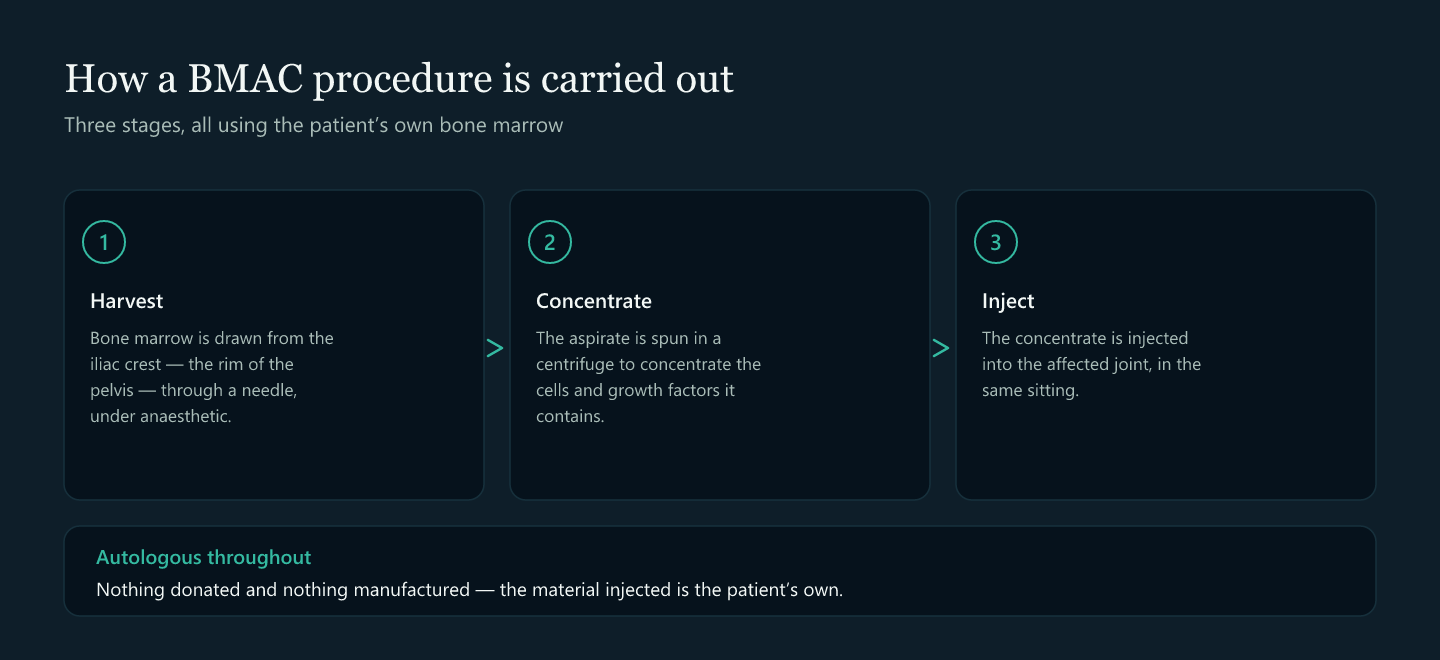
- Preparation and local anaesthesia: The patient lies comfortably while the posterior iliac crest area is thoroughly disinfected. Local anaesthetic is administered to numb the skin, subcutaneous tissues, and the periosteum of the pelvic bone.
- Bone marrow aspiration: Using a specialised aspiration needle, bone marrow (typically around 60 ml, as described in Pabinger et al., 2024) is aspirated gently from the iliac crest.
- Centrifugation and processing: The aspirate is processed immediately within the sterile field in a centrifuge. In the literature, two-spin protocols (such as 1200 rpm for 10 minutes followed by 2000–3000 rpm for 10–15 minutes, as reported in Medicina, 2025) are described to isolate approximately 5 ml of concentrated cellular fraction.
- Targeted joint injection: The knee joint is sterilely prepared, and the concentrated BMAC is injected into the intra-articular space, commonly via a lateral suprapatellar approach.
The entire process typically takes under two hours, after which the patient is monitored briefly before being discharged home on the same day.
Recovery and What to Expect After the Procedure
Because BMAC involves both a marrow harvest site and a joint injection site, patients experience a brief recovery phase. Orthopaedic recovery should always be understood in general terms rather than as a promised schedule:
- First 48 to 72 hours: Mild to moderate soreness at the pelvic harvest site and temporary fullness or stiffness in the knee joint are common. Simple analgesics and cold packs are commonly used to manage discomfort.
- First 1 to 2 weeks: Patients are generally advised to modify activities, avoiding high-impact exercise, deep squatting, or heavy lifting while resuming gentle daily walking as tolerated.
- 2 to 6 weeks: Low-impact rehabilitation exercises, often guided by physiotherapy, help restore joint mobility and strengthen supporting musculature.
- Symptom improvement timeline: Because BMAC works via cellular signalling and biological modulation rather than instant mechanical cushioning, meaningful pain relief and functional improvement are commonly noted between 6 to 12 weeks post-procedure, with benefits often building over subsequent months.
In terms of safety, Cavallo et al. (reviewed in Medicina, 2025) noted that repeated intra-articular BMAC procedures did not increase systemic complication or infection risks. In the 4-year cohort by Pabinger et al. (Scientific Reports, 2024), adverse events were limited to temporary knee soreness lasting about a week and one case of transient numbness from local anaesthesia lasting 8 hours, with no serious adverse events reported.
How Much Does BMAC Cost in Pakistan?
Understanding procedural costs is an essential part of treatment planning. In Pakistan, the cost of biological and surgical joint treatments varies across clinical settings. Published market rates in Pakistan reflect the following landscape:
- Platelet-Rich Plasma (PRP): General PRP therapy in Lahore ranges between PKR 15,000–30,000 (market rate, August 2026) per treatment, while dedicated joint injections in Islamabad start from PKR 25,000 per session (market rate, August 2026). Because PRP typically requires 3 to 4 sessions, the cumulative cost increases accordingly.
- Stem cell clinic injections: Commercial clinics advertising single-digestion stem cell injections for single joints typically charge PKR 100,000–150,000 (market rate, August 2026).
- Total knee replacement: For comparative perspective, total knee replacement in Lahore standardly ranges from PKR 400,000–900,000 (Lahore market range, August 2026), with government sector options around PKR 200,000 or less (market rate, August 2026) and private sector facilities ranging between PKR 700,000–1,500,000 (market rate, August 2026).
- Specialist consultation fees: Orthopaedic consultation fees in Lahore generally range between PKR 500–3,000 (market range, August 2026), varying by specialist experience.
Published market figures serve as general orientation. For individual clinical care, a specific financial estimate is provided following in-person examination and radiographic review.
Signs Generally Regarded as Needing Urgent Medical Evaluation
While chronic degenerative joint symptoms progress slowly over months or years, certain acute symptoms require urgent medical evaluation rather than an elective consultation. These include:
- Acute inability to bear any weight on the affected limb following trauma or sudden pain onset.
- Rapid, tense joint swelling developing within a few hours of an acute incident.
- A true mechanically locked joint that cannot be fully extended or straightened.
- Joint pain accompanied by fever, chills, spreading skin warmth, or localised redness, which may suggest infectious arthritis.
Clinical Consultation and Next Steps
Selecting the right approach for knee pain depends on an accurate clinical diagnosis, joint wear grading, and your individual mobility goals. Patients interested in broader non-operative treatments can read our detailed guide on alternatives to knee replacement.
To determine whether BMAC is an appropriate option for your joint, an in-person consultation with Professor Dr Farooq Azam Khan at his Lahore clinics provides a comprehensive orthopaedic evaluation, clinical imaging review, and an honest discussion of the most suitable treatment pathway.
Common questions
- What are BMAC injections used for?
- BMAC injections are primarily used in orthopaedics to manage moderate knee osteoarthritis, helping to reduce joint inflammation, alleviate chronic pain, improve mobility, and delay the need for joint replacement surgery.
- Do BMAC injections work?
- Published trials indicate that BMAC provides meaningful pain reduction and functional improvement over 12 to 24 months, with 4-year data from Pabinger et al. (Scientific Reports, 2024) showing sustained WOMAC score improvements (40 to 18) and delayed surgery, though the study lacked a blinded placebo control.
- How much does BMAC cost in Pakistan?
- While commercial clinics advertise single-joint stem cell therapy at PKR 100,000–150,000 (market rate, August 2026), hospital-based BMAC pricing depends on theatre processing and whether single or bilateral joints are treated. An exact quotation is determined during clinical consultation.
- Is BMAC FDA-approved?
- The US FDA regulates BMAC under 21 CFR Part 1271 (Section 361) as an autologous, minimally manipulated tissue product rather than an approved drug. Processing centrifuge devices are FDA-cleared, but no stem cell therapy is FDA-approved as a drug for knee osteoarthritis.
- How does BMAC differ from PRP therapy?
- BMAC is harvested from bone marrow and delivers mesenchymal stem cells, bioactive growth factors, and cytokines, providing clinical relief that commonly lasts 18 months or longer. PRP is derived from a peripheral blood draw, delivers platelet growth factors, and typically provides 6 to 12 months of relief.
- Is the bone marrow harvesting procedure painful?
- Bone marrow aspiration is performed under local anaesthesia to numb the skin, tissues, and pelvic bone. Most patients experience pressure rather than acute pain during harvest, followed by mild, manageable soreness for several days.
References
- Park D, Koh HS, Choi YH, Park I. Bone Marrow Aspirate Concentrate (BMAC) for Knee Osteoarthritis: A Narrative Review of Clinical Efficacy and Future Directions. Medicina (Kaunas), 2025.
- Pabinger C, Lothaller H, Kobinia GS. Intra-articular injection of bone marrow aspirate concentrate in KL grade III and IV knee osteoarthritis: 4 year results of 37 knees. Scientific Reports, 2024.
- US Food and Drug Administration. Regulatory Considerations for Human Cells, Tissues, and Cellular and Tissue-Based Products (21 CFR Part 1271).
Further reading
 Regenerative medicine
Can BMAC Delay Knee Surgery? Alternatives to Knee Replacement
Can BMAC delay joint replacement? Discover how bone marrow aspirate concentrate serves as one of the leading alternatives to knee replacement, reviewing 4-year study data, benefits, limitations, and when delaying surgery is inappropriate. Regenerative medicine
BMAC vs PRP: Which Injection Is Right for Your Knee?
BMAC vs PRP: an evidence-based comparison of bone marrow aspirate concentrate and platelet-rich plasma for knee osteoarthritis. Discover differences in cellular mechanism, relief duration, trial evidence, and costs in Pakistan. Knee replacement
When Is It Time for a Knee Replacement?
Knee pain does not need to mean surgery. Here are the signs that usually bring people to that conversation, what is normally tried first, and why the decision belongs in a consultation. Regenerative medicine · اردو
BMAC کیا ہے؟ گھٹنوں کے درد کا علاج اور نئی طبی رہنمائی
Ghutno ka dard aur ghutno ke dard ka ilaj — اردو میں جانیں کہ BMAC کیا ہے، ہڈی کے گودے سے تیار شدہ یہ طریقہ کار کیسے کام کرتا ہے، اس کے شواہد کی حدود کیا ہیں اور کون سے مریض اس کے لیے موزوں سمجھے جاتے ہیں۔