
Regenerative medicine
BMAC and Avascular Necrosis Treatment for the Hip
An evidence-based guide to avascular necrosis treatment of the hip. Learn about AVN causes, radiographic staging, joint preservation with core decompression and BMAC adjuncts, evidence limitations, and total hip replacement.

When diagnosing progressive hip pain in young and middle-aged adults, avascular necrosis treatment requires careful clinical staging and timely orthopaedic intervention. Avascular necrosis (AVN), also known as osteonecrosis of the femoral head, occurs when the blood supply to the bone is compromised, leading to bone cell death and the potential structural collapse of the hip joint. Patients researching joint preservation often ask whether bone marrow aspirate concentrate (BMAC) can help save the native hip.
At his practice in Lahore, consultant orthopaedic surgeon Dr Farooq Azam Khan evaluates complex hip disorders, offering both surgical reconstruction and biological joint preservation through the BMAC treatment in Lahore programme. This guide provides an honest, evidence-based overview of hip AVN, how surgeons stage the condition, where BMAC fits as a surgical adjunct, and why the evidence base in the hip is fundamentally distinct from knee arthritis.
What Is Avascular Necrosis of the Hip?
The femoral head (the ball of the hip joint) relies on a delicate network of terminal blood vessels. When this blood supply is interrupted, the living bone tissue inside the femoral head undergoes cellular necrosis. Over time, the weakened bone accumulates microfractures under daily walking weight. If left untreated in progressive cases, the spherical surface of the bone collapses, creating severe irregularity and rapid secondary osteoarthritis.
Common risk factors associated with avascular necrosis include:
- High-dose or prolonged corticosteroid use (frequently prescribed for autoimmune, respiratory, or dermatological conditions).
- Traumatic hip injuries, such as femoral neck fractures or hip dislocations, that disrupt delicate capsular blood vessels.
- Excessive chronic alcohol consumption, which can alter lipid metabolism and impair microvascular circulation.
- Haematological disorders, hypercoagulable states, or idiopathic cases where no single underlying cause is identified.
Avascular Necrosis Treatment: Early vs Advanced Disease
The single most critical factor in managing hip AVN is the timing of diagnosis. Orthopaedic treatment strategies are divided strictly according to whether the femoral head has retained its spherical shape (pre-collapse) or has collapsed mechanically (post-collapse):
- Pre-collapse stages (early disease): In early stages, plain X-rays may appear nearly normal, but magnetic resonance imaging (MRI) reveals diagnostic bone marrow oedema and focal necrotic boundaries. The femoral head remains structurally round. This is the only window in which joint preservation procedures are viable.
- Post-collapse stages (advanced disease): Once a subchondral fracture (often seen as a 'crescent sign' on X-rays) occurs and the spherical contour of the femoral head flattens, joint preservation is no longer clinically effective. Mechanical congruence is lost, leading to joint destruction.
How BMAC Is Used in Hip AVN: The Biological Adjunct
In pre-collapse avascular necrosis, standard surgical preservation involves a procedure called core decompression. A surgeon drills a narrow channel through the femoral neck into the necrotic zone of the femoral head to relieve elevated intraosseous pressure and stimulate vascular ingrowth.
In specialised joint preservation protocols, BMAC is introduced as an adjunct to core decompression. Concentrated bone marrow aspirate, harvested from the pelvic iliac crest and concentrated to isolate autologous mesenchymal stem cells and growth factors, is instilled directly into the core decompression channel. The biological objective is to deliver progenitor cells that may support local bone remodelling and vascular repair.
Understanding the Evidence Limits: Why Hip AVN Differs from the Knee
It is vital to state plainly that the clinical evidence base for BMAC in hip avascular necrosis is considerably more limited and less established than the evidence for knee osteoarthritis.
While knee osteoarthritis literature includes prospective cohort studies and comparative trials, published data for BMAC in hip AVN consists primarily of heterogeneous surgical series with variable staging and differing adjunct techniques. There are no definitive, standardised outcome figures that can be promised to a patient with hip AVN, and outcome numbers from knee osteoarthritis studies cannot be imported or applied to the hip.
BMAC should be understood strictly as an experimental biological adjunct discussed alongside core decompression in carefully selected early-stage cases. It cannot repair a collapsed femoral head, and it does not eliminate the potential future need for definitive hip reconstruction. Broader regenerative evidence principles are reviewed in our complete guide to BMAC in Pakistan.
When Total Hip Replacement Remains the Definitive Solution
For patients presenting with post-collapse avascular necrosis, persistent deep groin pain, significant limp, or secondary osteoarthritis, biological injections and core decompression are not appropriate. In this stage, total hip replacement is the established, highly successful standard of care.
Modern total hip arthroplasty replaces the damaged femoral head and worn acetabular socket with precision artificial components, reliably eliminating arthritic pain and restoring full functional mobility. Patients facing advanced disease can read our detailed guide on total hip replacement to understand surgical planning and rehabilitation.
Signs Generally Regarded as Needing Urgent Medical Evaluation
While avascular necrosis often causes progressive groin or thigh discomfort, certain acute symptoms require urgent medical evaluation rather than an elective clinic appointment:
- Sudden, severe inability to bear weight on the hip after minor movement, which may indicate a sudden structural bone collapse or pathological fracture.
- Acute hip pain accompanied by fever, chills, or systemic illness, which may suggest septic arthritis.
- Severe rest pain that prevents sleep and fails to respond to standard analgesics.
Clinical Consultation and Next Steps
Because avascular necrosis progresses over time, early and accurate diagnostic imaging is paramount. If you are experiencing persistent groin, buttock, or thigh pain, a dedicated clinical examination and pelvic MRI can establish the exact stage of your condition.
A formal consultation with Professor Dr Farooq Azam Khan at his Lahore clinics provides an objective assessment of your hip joint, ensuring you receive an honest recommendation between joint-preserving interventions and reconstructive surgery.
Common questions
- Can BMAC resolution avascular necrosis of the hip?
- No. BMAC cannot reverse structural bone collapse or guarantee a resolution for AVN. In early pre-collapse stages, it is sometimes used as a biological adjunct to core decompression to support bone healing, but published outcome data is limited.
- How is hip avascular necrosis diagnosed early?
- Early pre-collapse AVN is best diagnosed using magnetic resonance imaging (MRI), which can detect bone marrow oedema and vascular compromise before structural damage becomes visible on standard X-rays.
- Can BMAC be used if the hip has already collapsed?
- No. Once the femoral head has lost its spherical shape and collapsed, biological injections are not effective. In post-collapse stages, total hip replacement is the standard and most reliable treatment.
- How does BMAC for the hip differ from BMAC for the knee?
- In the knee, BMAC is typically injected directly into the joint space for cartilage osteoarthritis. In the hip, BMAC is used primarily as an intraosseous surgical adjunct placed directly into the bone during core decompression for pre-collapse AVN.
References
Further reading
 Hip replacement
Total Hip Replacement: What to Expect
If you are considering a total hip replacement, this article provides a plain-language guide to the procedure, the components used, and the typical recovery journey, from the day of surgery to the weeks that follow.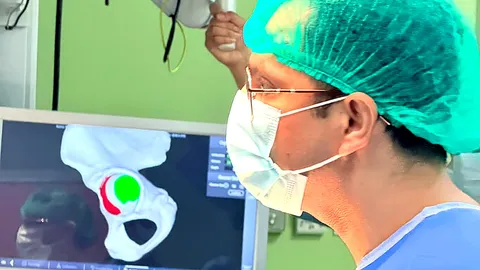 Hip replacement
A Robot Came to Lahore: What the First Robotic Hip Replacement at Sharif Medical City Actually Means
On 28 July, SUNO News reported the first robotic-assisted hip replacement at Sharif Medical City Hospital, Lahore. Here is what the technology does, what the evidence says it is worth, and how the same scene is playing out from Nairobi to Glasgow. Hip replacement
What Drives the Cost of Hip Replacement in Pakistan
A breakdown of the factors that determine the total cost of a hip replacement in Pakistan, explaining why a single price doesn't exist and what to expect in a consultation. Knee replacement
Free and Subsidised Joint Replacement in Pakistan: How the National Health Card Works
Many patients ask about free knee replacement surgery in Pakistan. This article explains how government schemes like the National Health Card (Sehat Sahulat Programme) and other financial assistance routes may work for joint replacement, and clarifies the steps to verify your eligibility in person.