
Regenerative medicine
BMAC and Stem Cell Therapy in Pakistan: The Crucial Differences
An evidence-based guide to stem cell therapy in Pakistan and BMAC. Discover key differences between hospital-based orthopaedic cell therapy and commercial clinic claims, international FDA regulations, and essential questions to ask.
In recent years, interest in stem cell therapy in Pakistan has grown rapidly among patients seeking non-surgical relief for chronic knee pain and arthritis. However, the commercial marketplace is crowded with marketing claims that often blur the line between verified orthopaedic medicine and unproven commercial treatments. Patients considering regenerative therapies must understand how hospital-based bone marrow aspirate concentrate (BMAC) differs fundamentally from commercial 'stem cell' offerings.
At his Lahore practice, consultant orthopaedic surgeon Dr Farooq Azam Khan provides the first hospital-based BMAC treatment in Lahore programme, applying international protocols adapted into conservative clinical guidelines. This guide breaks down the biological, regulatory, and procedural differences between evidence-based orthopaedic cell therapy and commercial clinic marketing.
Stem Cell Therapy in Pakistan: Clinical Reality vs Marketing
Commercial wellness and cosmetic centres frequently market cell therapies with promises of cartilage regeneration, permanent pain relief, and complete joint restoration. From a scientific orthopaedic perspective, these claims misrepresent what biological therapies can achieve.
In legitimate orthopaedic practice, cell therapy is never presented as a reliable method to regrow destroyed cartilage. Instead, it is an advanced biological tool designed to modulate the joint environment. By delivering a concentrated mixture of mesenchymal stem cells (MSCs), platelets, and anti-inflammatory cytokines, BMAC helps calm chronic synovial inflammation, alleviate joint discomfort, and buy healthy active years before definitive joint replacement is required.
Autologous Minimal Manipulation vs Commercial Culture
To evaluate cell therapy objectively, patients should understand the key technical distinctions between verified point-of-care preparations and unverified commercial products:
- Autologous tissue: BMAC uses only the patient's own bone marrow, aspirated from the pelvic iliac crest and reinjected during the same operative session, eliminating the risk of foreign tissue rejection.
- Minimal manipulation: The harvested marrow undergoes only physical centrifugation to concentrate cellular layers. It is not grown, cultured, or chemically manipulated in an external laboratory.
- Homologous orthopaedic use: Cells harvested from the musculoskeletal system (bone marrow) are transferred to a musculoskeletal structure (the knee joint) to perform native biological functions.
- Commercial allogeneic and expanded products: Some commercial clinics advertise donor-derived products, such as umbilical cord or amniotic extracts, or culture-expanded cells. These products lack long-term orthopaedic safety and efficacy data and carry higher biological uncertainty.
International Regulatory Status: Is BMAC FDA-Approved?
Patients frequently encounter confusing claims regarding 'FDA approval' in commercial advertising. Understanding international regulatory frameworks helps establish realistic expectations:
In the United States, the Food and Drug Administration (FDA) regulates human cellular therapies under 21 CFR Part 1271 as Human Cells, Tissues, and Cellular and Tissue-Based Products (HCT/Ps). BMAC is categorised under the Section 361 regulatory exception, which permits autologous, minimally manipulated tissues intended for homologous use without requiring the multi-phase pharmaceutical drug approval pathway.
Crucially, no stem cell product is FDA-approved as a pharmaceutical drug for orthopaedic knee osteoarthritis, and BMAC itself is not FDA-approved as a drug. While the centrifuge processing devices used to prepare BMAC are FDA-cleared for clinical safety, device clearance is not equivalent to drug approval for the biological therapy. Commercial clinics that claim their stem cell injections are 'FDA-approved drugs' are misrepresenting this distinction.
Furthermore, the FDA is a United States regulatory agency and does not govern medical practice in Pakistan. This framework is presented purely as international scientific context, as there is currently no specific drug approval for BMAC from local Pakistani regulatory authorities.
Hospital Operating Theatre vs Outpatient Commercial Clinic
Where and by whom a biological procedure is performed fundamentally impacts patient safety and diagnostic rigor:
- Surgical theatre environment: In hospital-based practice, BMAC is performed in a fully equipped operating theatre with strict laminar airflow and surgical sterility, minimising the risk of joint sepsis.
- Orthopaedic specialist oversight: The procedure is evaluated, harvested, and administered by a consultant orthopaedic surgeon who understands joint mechanics, surgical alternatives, and exact anatomic needle placement.
- Objective radiographic candidacy: An orthopaedic surgeon uses standing weight-bearing radiographs and validated joint scores to confirm that the patient has viable joint space (Kellgren–Lawrence grade II–III) rather than severe bone-on-bone collapse.
- Commercial clinic settings: In contrast, commercial wellness centres often perform injections in standard treatment rooms without surgical sterility and without comprehensive orthopaedic evaluation.
Pricing Context in Pakistan: Comparing Market Rates
Cost is another area where commercial marketing can be misleading. In Pakistan, published market rates reflect distinct tiers:
- Commercial stem cell clinics: Clinics advertising single-digestion stem cell injections for single joints advertise rates between PKR 100,000–150,000 (market rate, August 2026).
- Platelet-Rich Plasma (PRP): General PRP therapy in Lahore ranges between PKR 15,000–30,000 (market rate, August 2026) per treatment, as detailed in clinical market surveys.
- Total knee replacement: Total knee replacement in Lahore standardly ranges from PKR 400,000–900,000 (Lahore market range, August 2026).
- Specialist consultation: Specialist orthopaedic consultations in Lahore range between PKR 500–3,000 (market range, August 2026).
Five Essential Questions to Ask Any Stem Cell Clinic
If you are consulting a clinic offering cellular or regenerative therapy for joint pain, asking the following objective questions will help protect your health and finances:
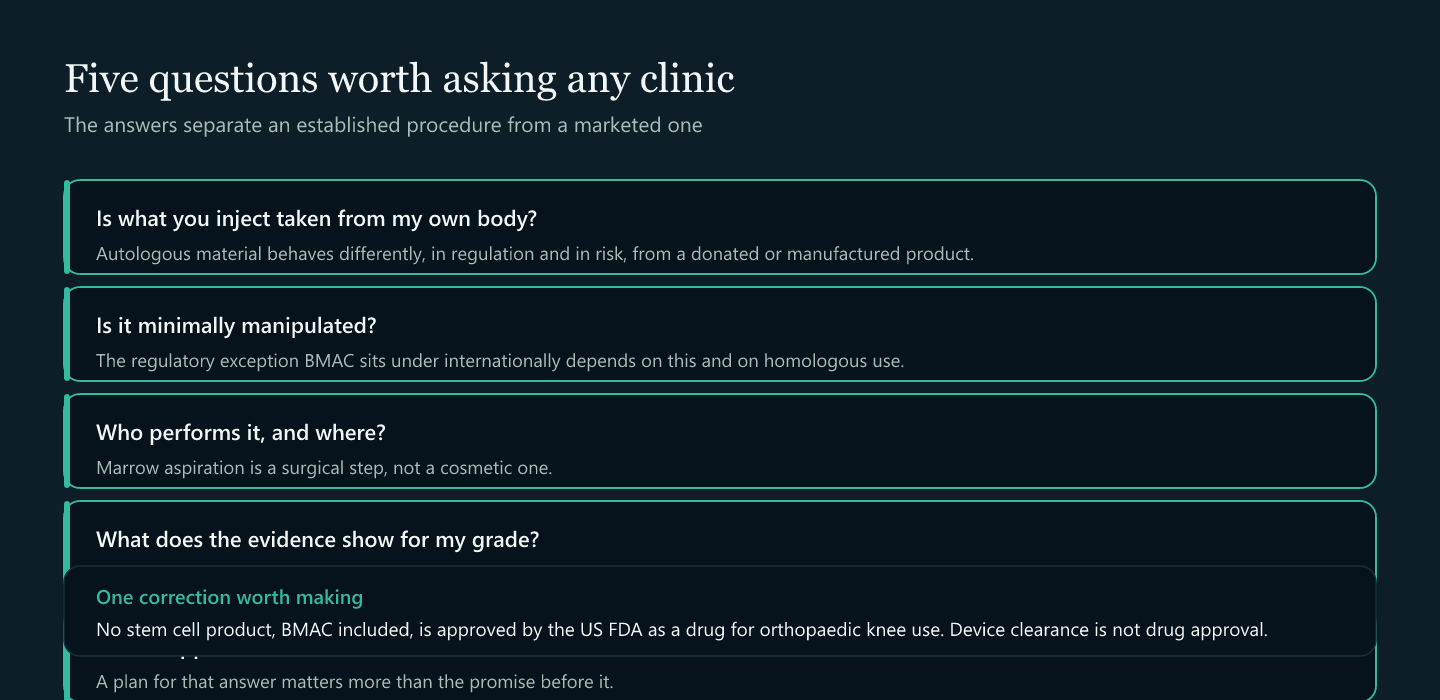
- 1. What is the exact tissue source? (Confirm whether the cells are autologous from your own bone marrow or derived from unverified donor tissue.)
- 2. Are the cells minimally manipulated at the point of care? (Verify that cells are processed immediately via simple centrifugation without off-site laboratory culture or chemical additives.)
- 3. Is the procedure performed in a sterile hospital operating theatre by a qualified orthopaedic surgeon?
- 4. What objective radiographic grading is being used to assess my joint? (Confirm whether standing X-rays show viable joint space or end-stage mechanical collapse.)
- 5. What are the realistic clinical goals? (Be cautious if the clinic promises complete cartilage regeneration or a promised permanent resolution rather than conservative symptom management and surgical delay.)
Signs Generally Regarded as Needing Urgent Medical Evaluation
While chronic joint pain develops over time, certain acute symptoms require urgent medical evaluation rather than an elective clinic appointment:
- Inability to bear any weight on the leg following acute pain onset.
- Sudden, tense swelling developing rapidly within hours.
- A true mechanical locking of the joint that prevents straightening.
- Joint pain accompanied by fever, chills, spreading skin redness, or warmth, which may indicate joint infection.
Clinical Consultation and Next Steps
To learn more about clinical trial evidence, review our complete guide to BMAC in Pakistan, or explore biological mechanisms in BMAC vs PRP.
An in-person consultation with Professor Dr Farooq Azam Khan at his Lahore clinics provides an honest, evidence-based orthopaedic assessment to determine whether biological joint preservation is appropriate for your joint.
Common questions
- Is BMAC the same as stem cell therapy?
- BMAC is an evidence-based form of autologous cell therapy that uses concentrated bone marrow containing mesenchymal stem cells, platelets, and cytokines. It differs from commercial 'stem cell' clinics that often market unverified, culture-expanded or donor products.
- Can stem cell injections regrow destroyed knee cartilage?
- No. There is no conclusive scientific evidence proving that stem cell injections regrow pristine articular cartilage in an arthritic knee. BMAC works by reducing inflammation, managing pain, and slowing degeneration to buy healthy years.
- Is BMAC FDA-approved for knee osteoarthritis?
- No. The US FDA regulates BMAC under Section 361 as an autologous, minimally manipulated tissue product rather than an approved pharmaceutical drug. Centrifugation devices are FDA-cleared, but no stem cell therapy is FDA-approved as a drug for knee osteoarthritis.
- Why is BMAC performed in an operating theatre rather than a clinic room?
- Performing bone marrow aspiration and joint injection in a laminar airflow operating theatre ensures strict surgical sterility, minimising the risk of joint infection while providing full patient monitoring.
- What should I look for when choosing a regenerative medicine provider?
- Ensure the provider is a qualified consultant orthopaedic surgeon who performs the procedure in a hospital theatre, uses autologous minimally manipulated tissue, and bases recommendations on objective standing radiographs.
References
- Park D, Koh HS, Choi YH, Park I. Bone Marrow Aspirate Concentrate (BMAC) for Knee Osteoarthritis: A Narrative Review of Clinical Efficacy and Future Directions. Medicina (Kaunas), 2025.
- US Food and Drug Administration. Regulatory Considerations for Human Cells, Tissues, and Cellular and Tissue-Based Products (21 CFR Part 1271).
Further reading
 Regenerative medicine
BMAC Injection Cost in Pakistan (2026): Pricing Guide
An evidence-based guide to BMAC injection cost in Pakistan (2026). Explore bone marrow aspirate concentrate practice pricing, comparisons with PRP and knee replacement surgery, key cost drivers, and consultation planning. Regenerative medicine
BMAC for Sports Injuries: Where It Fits and Where It Does Not
An evidence-based guide to BMAC for sports injuries. Understand where bone marrow aspirate concentrate fits in athletic recovery, why it cannot repair complete ACL ruptures, and how partial ligament, meniscus, and cartilage injuries are managed. Regenerative medicine
BMAC and Avascular Necrosis Treatment for the Hip
An evidence-based guide to avascular necrosis treatment of the hip. Learn about AVN causes, radiographic staging, joint preservation with core decompression and BMAC adjuncts, evidence limitations, and total hip replacement. Knee replacement
Bilateral Knee Replacement: Both Knees, One Decision
Considering replacing both knees? Learn about the differences between simultaneous (one surgery) and staged (two surgeries) bilateral knee replacement, including the trade-offs for recovery and who might be a candidate.