
Regenerative medicine
BMAC vs PRP: Which Injection Is Right for Your Knee?
BMAC vs PRP: an evidence-based comparison of bone marrow aspirate concentrate and platelet-rich plasma for knee osteoarthritis. Discover differences in cellular mechanism, relief duration, trial evidence, and costs in Pakistan.

When managing chronic knee pain and joint stiffness, patients frequently ask about BMAC vs PRP: which biological injection offers the right balance of effectiveness, durability, and convenience? Both bone marrow aspirate concentrate (BMAC) and platelet-rich plasma (PRP) are autologous orthopaedic treatments that use the patient's own biological material to treat joint inflammation and support tissue health. However, they differ substantially in their cellular composition, invasiveness, duration of symptom relief, and clinical indication.
In Lahore, where PRP therapy has been widely accessible for years, the introduction of the first hospital-based BMAC treatment in Lahore programme by Dr Farooq Azam Khan provides an advanced alternative for patients with moderate joint degeneration. This guide compares BMAC and PRP across scientific mechanisms, published clinical trials, procedural steps, and costs in Pakistan to help you understand which treatment aligns with your joint condition.
BMAC vs PRP: Comparing Biological Mechanisms and Cell Source
The primary distinction between BMAC and PRP lies in the tissue source and the resulting cellular concentration:
- Platelet-Rich Plasma (PRP): Derived from a standard peripheral blood draw from the arm. The blood is centrifuged to isolate a high concentration of platelets. Platelets release bioactive growth factors that stimulate local tissue repair and temporarily reduce synovial inflammation.
- Bone Marrow Aspirate Concentrate (BMAC): Harvested from the patient's pelvic bone (posterior iliac crest) under local anaesthesia. Centrifugation concentrates not only platelets and growth factors, but also nucleated cells including mesenchymal stem cells (MSCs) and powerful anti-inflammatory cytokines like IL-1Ra.
As noted in the comprehensive literature review by Park et al. in Medicina (2025), PRP relies on short-lived growth-factor stimulation, typically providing clinical benefits for 6 to 12 months. In contrast, BMAC delivers a complex cellular niche that may support longer-term joint environment modulation, with published literature reporting symptom relief lasting 18 months or longer.
Head-to-Head Comparison: BMAC and PRP at a Glance
The following table summarises the structural, clinical, and procedural differences between the two biological therapies based on published evidence:
| Clinical Parameter | BMAC | PRP |
|---|---|---|
| What is injected | Concentrated bone marrow containing mesenchymal stem cells (MSCs), platelets, and bioactive anti-inflammatory cytokines | Concentrated platelets from blood delivering concentrated growth factors |
| Source tissue | Autologous bone marrow aspirated from the pelvic iliac crest | Autologous peripheral blood drawn from an arm vein |
| Biological mechanism per Medicina (2025) | Delivers MSCs and bioactive factors that may support longer-term cellular signalling and cartilage environment modulation | Relies on short-lived growth-factor stimulation to calm synovial inflammation |
| Duration of relief per Medicina (2025) | Typically 18 months or longer | Typically 6 to 12 months |
| Head-to-head clinical evidence | Mixed: Dulic et al. and El-Kadiry et al. favour BMAC; Anz et al. found no statistically significant difference between groups | Effective for early-stage disease; comparable short-term symptom relief in some trials |
| Procedure invasiveness | Involves pelvic marrow aspiration under local anaesthesia; performed in a sterile operating theatre | Simple peripheral blood draw; performed in an outpatient clinic room |
What Clinical Trials Show: Dulic, El-Kadiry, and the Anz Equivalence Finding
When comparing BMAC directly against PRP in knee osteoarthritis, published randomised controlled trials (RCTs) present nuanced findings:
- Dulic et al. (RCT, 175 patients, 12 months): In a large randomised trial reviewed in Medicina (2025), BMAC produced statistically significantly greater improvements in pain and functional outcomes compared to both PRP and hyaluronic acid across all clinical scoring measures (p < 0.001).
- El-Kadiry et al. (Retrospective study, 39 patients, 12 months): Patients receiving BMAC demonstrated superior clinical outcomes compared to PRP, showing a 29% greater improvement in Visual Analogue Scale (VAS) pain scores, 54% greater gains in KOOS scores, and 52% greater gains in WOMAC scores (p < 0.01).
- Anz et al. (RCT, 90 patients, 1 to 12 months): In contrast, this rigorous randomised trial found that while both BMAC and PRP produced statistically significant improvements in knee symptoms (p < 0.001), there was no statistically significant difference between the BMAC group and the PRP group at any follow-up time point.
Furthermore, international reviews highlight that one randomised placebo-controlled trial found no statistically significant difference in pain reduction between BMAC and saline injections (p > 0.09). Without long-term studies of five or more years and routine MRI evaluations, it remains unproven whether either injection alters the underlying disease progression or regrows cartilage. Full details on clinical evidence are explored in our complete guide to BMAC in Pakistan.
When Is PRP Still the Better Choice?
Despite the higher cellular potency of BMAC, PRP remains a highly effective, practical, and preferred clinical choice in specific patient scenarios:
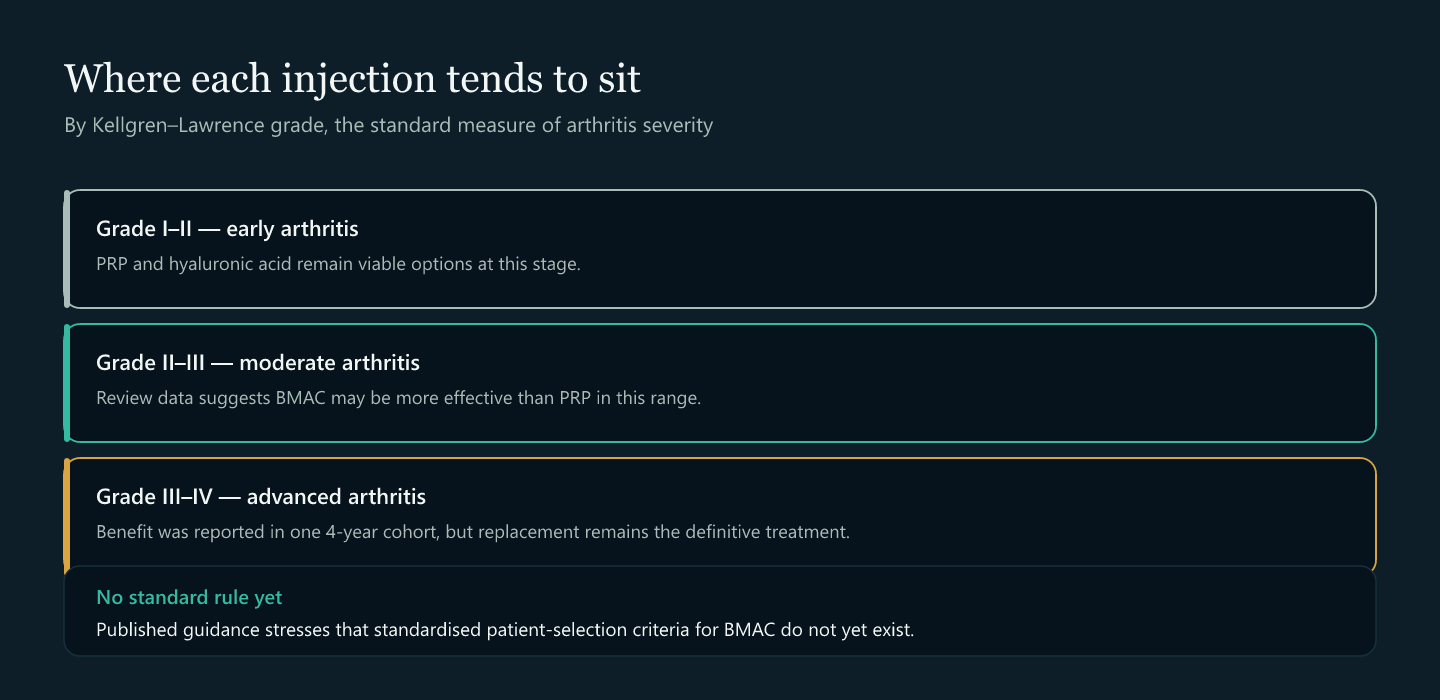
- Early-stage osteoarthritis: For patients with mild joint wear (Kellgren–Lawrence grade I–II), PRP provides substantial anti-inflammatory relief without the need for bone marrow aspiration.
- Outpatient convenience: PRP requires only a routine arm blood draw and can be administered rapidly in a standard clinic setting.
- Shorter recovery time: Because there is no bone marrow harvest site, patients experience minimal post-procedure soreness and can resume light activities immediately.
- Lower single-session cost: For patients managing treatment on a per-session budget, PRP has a substantially lower entry cost per injection.
When Is BMAC Worth the Extra Step?
BMAC involves an operating theatre procedure and marrow harvest, making it a more involved intervention. However, it is clinically worth the extra step in specific situations:
- Moderate osteoarthritis: For patients with Kellgren–Lawrence grade II–III osteoarthritis where structural cartilage wear is more pronounced, the broader cellular and cytokine payload of BMAC may provide deeper symptom control.
- Previous short-lived PRP relief: Patients who experienced symptom recurrence within a few months of PRP therapy often benefit from the longer duration of relief (18 months or longer) associated with BMAC.
- Buying time before surgery: Active individuals aged 55 and older seeking to postpone total knee replacement surgery for several years find BMAC a compelling joint preservation option.
As emphasised in Medicina (2025), standardised patient-selection guidelines do not yet exist, meaning treatment decisions must be tailored individually through detailed radiographic assessment and physical examination.
Cost Comparison: Single Procedure vs Repeated Sessions in Pakistan
When evaluating costs, comparing a single BMAC procedure to a single PRP injection can be misleading without accounting for protocol differences. Published market rates in Pakistan reflect the following figures:
- PRP therapy in Lahore: General PRP therapy in Lahore ranges between PKR 15,000–30,000 (market rate, August 2026) per treatment, varying with clinic expertise and preparation kit. In Islamabad, published rates start from PKR 25,000 per session (market rate, August 2026), while general advertised ranges across Pakistan span PKR 11,999–19,999 and PKR 14,999–24,999 per session (market rate, August 2026).
- The repetition factor: A critical consideration is that PRP protocols standardly require 3 to 4 injection sessions spaced weeks apart to achieve optimal results. This repeated requirement multiplies the total financial investment.
- BMAC single-procedure protocol: BMAC is performed as a single comprehensive theatre procedure delivering concentrated MSCs and bioactive factors, reducing the need for frequent repeat clinic visits.
- Surgical context: For broader perspective, total knee replacement in Lahore standardly ranges from PKR 400,000–900,000 (Lahore market range, August 2026). Commercial single-digestion stem cell injections in Pakistan advertise between PKR 100,000–150,000 (market rate, August 2026).
Signs Generally Regarded as Needing Urgent Medical Evaluation
While chronic joint pain from osteoarthritis is managed electively, certain symptoms indicate acute pathology requiring urgent medical evaluation rather than a routine outpatient appointment:
- Inability to bear weight on the leg after sudden twisting or minor trauma.
- Rapid onset of tense, severe joint swelling within hours.
- A mechanically locked knee joint that cannot be extended.
- Joint pain accompanied by fever, spreading erythema (redness), or systemic illness, which may indicate a joint infection.
Clinical Consultation and Next Steps
Choosing between BMAC and PRP is not a matter of one being universally superior; it is a clinical decision based on your radiographic arthritis grade, pain severity, prior treatment responses, and functional goals. You can explore broader non-surgical treatments in our guide to alternatives to knee replacement.
An in-person consultation with Professor Dr Farooq Azam Khan at his Lahore clinics provides a comprehensive orthopaedic evaluation and weight-bearing imaging review to determine whether PRP, BMAC, or alternative joint preservation strategies are right for you.
Common questions
- Which is more effective for knee osteoarthritis, BMAC or PRP?
- Clinical trials show mixed findings: trials by Dulic et al. and El-Kadiry et al. found BMAC superior in moderate osteoarthritis, whereas an RCT by Anz et al. showed both treatments provided similar symptom relief over 12 months. BMAC is generally preferred for moderate arthritis, while PRP is effective in early-stage disease.
- How long do the benefits of BMAC last compared to PRP?
- According to scientific literature reviewed in Medicina (2025), PRP typically provides 6 to 12 months of symptom relief, while BMAC commonly delivers benefits lasting 18 months or longer due to its cellular and cytokine concentration.
- Is the bone marrow harvesting for BMAC painful?
- The harvest from the pelvic iliac crest is performed under local anaesthesia to numb the area thoroughly. Patients typically feel pressure during aspiration rather than sharp pain, followed by mild soreness for several days.
- Why is PRP cheaper per injection than BMAC?
- PRP requires only a simple peripheral arm blood draw processed in an outpatient clinic room, whereas BMAC involves bone marrow aspiration, specialised centrifugation, and sterile operating theatre processing.
- Can I switch to BMAC if PRP injections stop working?
- Yes. Patients with moderate osteoarthritis who previously experienced only short-lived relief from PRP frequently consider BMAC to obtain a longer-lasting biological response before considering surgical options.
References
- Park D, Koh HS, Choi YH, Park I. Bone Marrow Aspirate Concentrate (BMAC) for Knee Osteoarthritis: A Narrative Review of Clinical Efficacy and Future Directions. Medicina (Kaunas), 2025.
- Pabinger C, Lothaller H, Kobinia GS. Intra-articular injection of bone marrow aspirate concentrate in KL grade III and IV knee osteoarthritis: 4 year results of 37 knees. Scientific Reports, 2024.
Further reading
 Regenerative medicine
BMAC and Stem Cell Therapy in Pakistan: The Crucial Differences
An evidence-based guide to stem cell therapy in Pakistan and BMAC. Discover key differences between hospital-based orthopaedic cell therapy and commercial clinic claims, international FDA regulations, and essential questions to ask. Regenerative medicine
BMAC Injection Cost in Pakistan (2026): Pricing Guide
An evidence-based guide to BMAC injection cost in Pakistan (2026). Explore bone marrow aspirate concentrate practice pricing, comparisons with PRP and knee replacement surgery, key cost drivers, and consultation planning. Regenerative medicine
BMAC for Sports Injuries: Where It Fits and Where It Does Not
An evidence-based guide to BMAC for sports injuries. Understand where bone marrow aspirate concentrate fits in athletic recovery, why it cannot repair complete ACL ruptures, and how partial ligament, meniscus, and cartilage injuries are managed. Knee replacement
How Long Does a Knee Replacement Last?
A modern knee replacement is a durable medical device, but it does not have a fixed expiry date. This article explains the factors that influence its longevity, from your activity level to the importance of regular follow-up with your surgeon.